Sunday, December 10, 2006

Panagia Ahiropiitos


Posted by Picasa
Well, on Saturday night, we went out just so I'd have something to write about on here! ( ;


As we sometimes do, we went downtown to Panagia Ahiropiitos for Vespers. While I was waiting to speak with Fr. Spyridon afterward, I took a couple pictures. The church is absolutely enormous, so the flash does nothing.


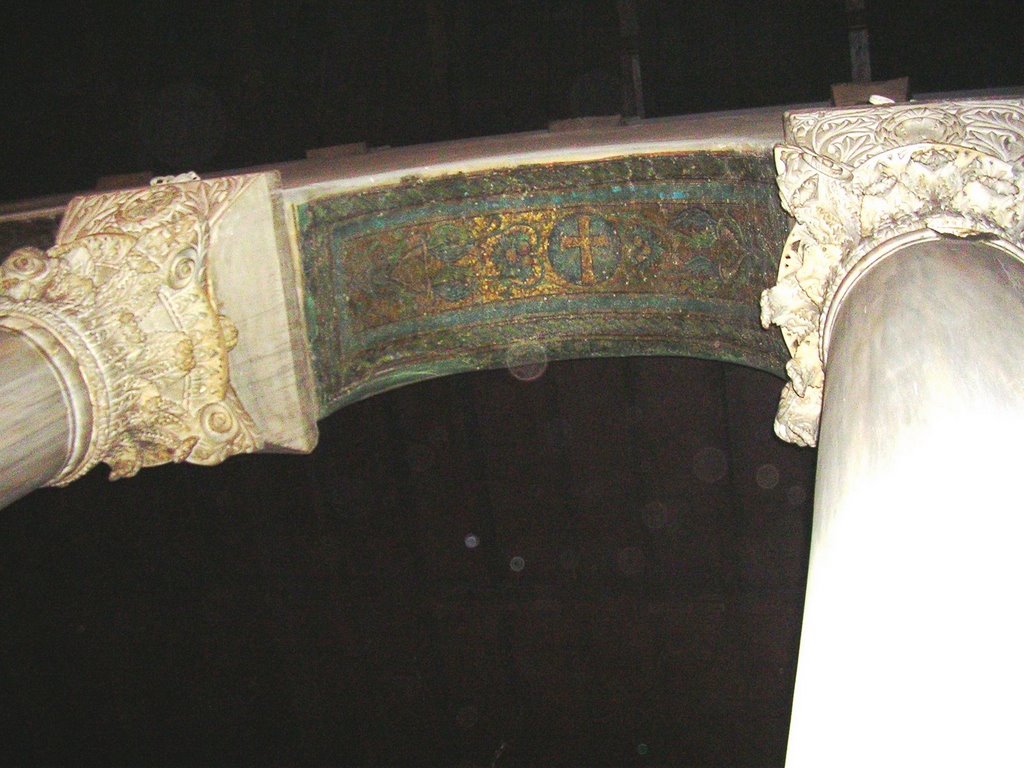
The church itself dates from the 5th century, as I think I've said before. Of course, time and the Turks destroyed much of the iconography, but some beautiful figural mosaics (the Turks could tolerate these images) survive, which probably date to the iconoclastic period (ca. 8th century).


The top photo is of one of the mosaics on the underside of the arches which line the inner narthex, and the bottom photo is of the apse.


The photos just don't do justice to the immense scale.

Saturday, December 09, 2006

Acquiring the Greek 'Phronema'

I've been thinking about a coffee I had with a Greek friend after church a few weeks ago, and what it revealed to me about the Greek mindset.


First, in Panorama (as everywhere in Greece), there are about 500 cafes -- a ratio of about 1 cafe to every 8 people, I think. Of course, though, only about 3 of these cafes are actually occupied at any one time, because everyone has to go to the same cafe.


So, anyway, I asked my Greek friend to have a coffee with me after church one Sunday a few weeks ago (so that I can practice conversational Greek), and he, of course, wanted to go to the most popular (read: crowded) cafe in town. So off we went. First, we had to push and squeeze our way through the doors, and then we proceeded to circle about the place like vultures looking (through the dense haze of smoke) for a empty cubic foot of space into which we could shoehorn ourselves.


Finally, like an oasis in the desert, I saw the impossible: an enormous table with bench seats, tucked away in a quite, forgotten corner of the cafe. And what's more, it was occupied by an American couple I knew, and they said, "Here you go, we were just about to leave." What luck! I called to my friend, Paris, and showed him the table.


No. He didn't like it. He confided in me: "That's ok for Fr. Alexi -- he would like it, because he's a priest. But we, we're young -- let's go over here." To my horror, he pointed to the exact middle of this swarming beehive of activity. The tables here were -- really -- about 18 inches in diameter and you had these impossibly tiny seats around them. All I could see through the smoke was flesh pressed against flesh, and all I could hear through the din was the constant ringing of cell phones. I looked at his face to see if he was joking. He wasn't.


Not wanting to argue, I thanked the American couple and -- to their utter bewilderment -- passed on taking their table. We then plunged into the heart of the Greek cafe jungle and, through a few well-chosen elbows, managed to make our way to a table. It was here that we were finally able to shout at each other in conversation. My friend looked delighted.


Now this seems like a rather simple, boring story of getting a coffee. But the more I thought about it afterwards, the more I began to understand the Greek mindset. It's often puzzled me why -- for instance -- if you are on a deserted beach in summer that stretches for miles (or kilometers...), and a Greek couple comes along, they will inevitably sit down right beside you. Now I began to formulate a theory -- they actually like being so close to everyone. Whereas Americans feel comfortable when they have some 'personal space,' this actually makes Greeks feel isolated. They like being right in the middle of the action. If everyone is having fun, then you will also have fun by inserting yourself in the middle of the gaiety.


This also contributes to my understanding of the Greeks in other public spaces, such as the church and buses. Here also, they seem quite satisfied to be so tightly packed that you can stand without any effort on your own.


As an epilogue to my story, the following Sunday, Pelagia and I went out for coffee again with our friend Paris so that we could practice Greek. (Incidentally, he's very kind to have this sort of patience with us.) Anyway, for some reason, we didn't have a whole lot of time. So when we went to the usual cafe and it was even more crowded than before, we decided we didn't have time to wait. So we went to another cafe near our house that our friend had heard just opened after a remodeling.


Now keep in mind I had told Pelagia of my adventure the previous Sunday. So as we arrived at this other cafe (which was beautiful, and had a breathtaking overview of the city and gulf), our friend immediately noticed that they weren't many cars there (that is, they weren't parked all over the sidewalks). So he said, disappointed, "Oh, it doesn't look like very many people are here. Should we go somewhere else?"


"No!" Pelagia said quickly. "Um, I mean: No, no, that's ok. We don't want to make you drive somewhere else. Let's just stay here." I suppressed a laugh, as I knew exactly what she was thinking. He did end up liking it, because the view was so nice, and we were able to practice some Greek (and he, his English), so it all worked out.
Friday, December 08, 2006

Buying a Donkey?

As Pelagia and I walked to Vespers tonight in our little 'village' of Panorama, we passed an old Greek man leading his donkey through town! The donkey was, evidently, carrying his groceries for him.


After this, we decided that we should get a donkey rather than a car -- it would be a lot cheaper and probably more reliable. With the traffic here, it would probably be just about as fast too.


Seriously, though, after doing some research on buying a car here, it seems less and less likely. The cars we were looking at for 2000 Euros were really not very good -- they could easily break down tomorrow and then we'd be out 2000 Euros. As our neighbor Ann put it, it's a 'false economy.' It seems like we're getting a car for cheap, but really we're just postponing payments in the form of endless repairs.


Everyone suggested that if we're going to get a car it would be better to spend say 5000-6000 Euros up front and get a little Toyota that's only a 3-4 years old. It could then be resold when we leave.


I've concluded that this really is the best way to go, but it's just too much money. 2000 was a reach! So, I think we're off this kick for now, unless/until something changes.


Meanwhile, I'm desperate to do something exciting that I can take pictures of and write about here, but sadly pretty much all we do is study Greek, go to church, etc. Nothing too exciting. A couple trips were planned by the School of Modern Greek but were then canceled at the last minute due to lack of participation. We keep hoping to tag along with some friends with cars, but those trips never materialize. 'Plans,' if they may be called such here, are very fluid -- you're never really sure what the day will have in store for you. It's taking some getting used to.


Anyway, all for today -- I will try to write again this weekend!

Saturday, December 02, 2006

Buying a Car in Greece?


Posted by Picasa
Well, the bus system finally has us so frustrated that we're thinking about possibly buying an old car. There are many downsides, however.


1. Greek drivers are crazy. There don't seem to be any rules. We've been told in all seriousness that they consider STOP signs suggestive only.


2. Obviously, cars are expensive. If we buy an older (i.e. cheaper) car, then we're risking significant, costly repairs down the road.


3. You can't trust anything anyone tells you about a used car. It's common -- no, routine -- for mechanics to roll back the odometer and just completely fabricate new service logs.


4. No one seems sure what bureaucracy we have to negotiate to legally own a car. It seems we need a Greek tax-ID number, which (as with all such government papers) will probably be a BIG hassle.


All that being said, it's proving nearly impossible to accomplish anything without a car, especially from out here in Panorama. As just one example, some days it has taken me 1.5 or 1.75 hours to get from Panorama to the University downtown on the bus. I spend at least 2 hours a day crammed into a bus (and I do mean crammed -- the idea of 'personal space' is QUITE foreign here), with all the windows sealed shut and someone's armpit in my face. By car, it would have been 30 minutes maximum, and I would be able to have fresh air.


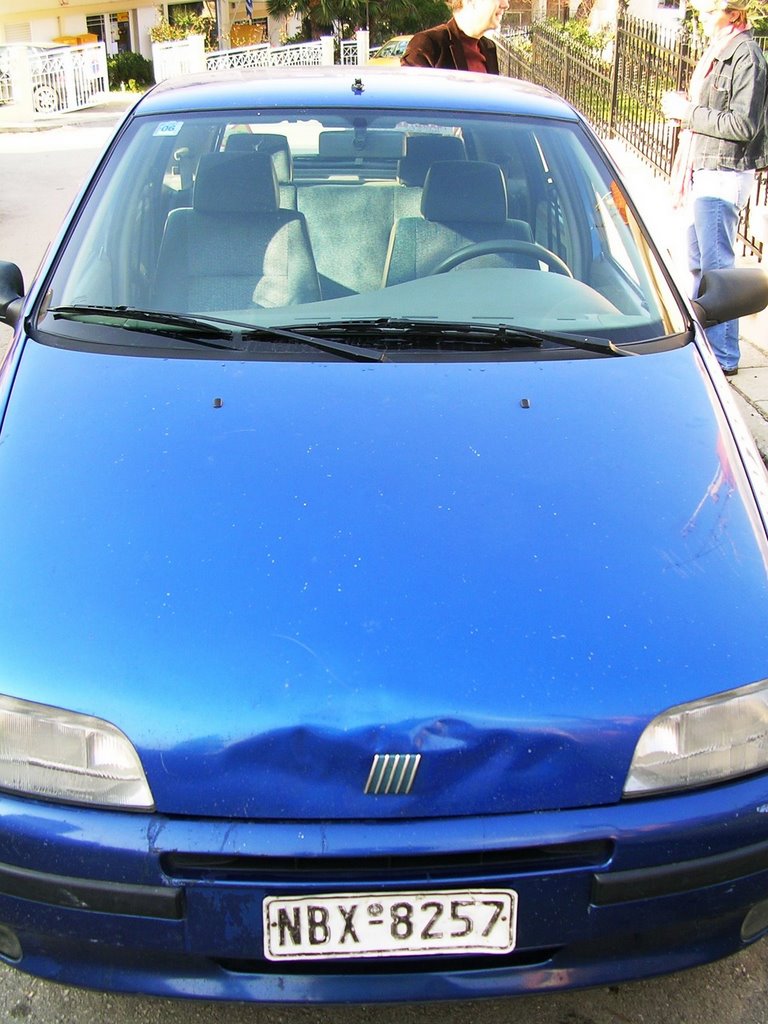
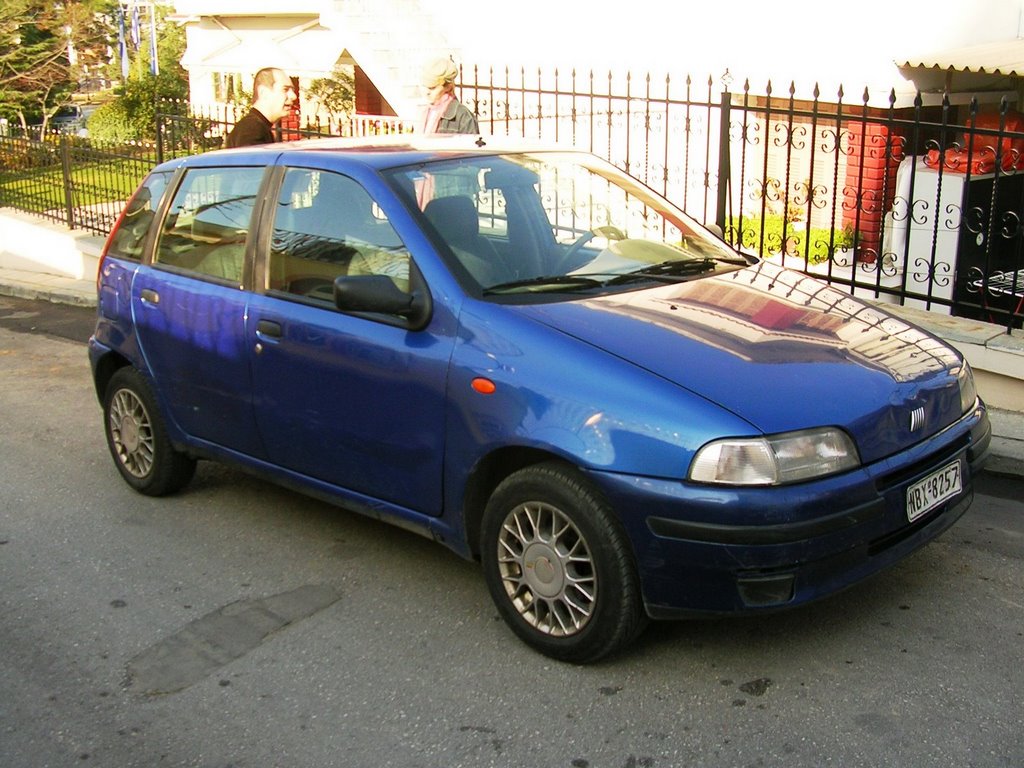
All that being said, we've begun cautiously asking friends if they know someone selling a reliable old car. One of the priests at our church here in Panorama, Fr. Panoyioti, has a friend selling his old car and we arranged to meet this morning at the church and test drive it. (See the pictures.) It's a 1997 Fiat Punto 1.3 CC with 208,000 km (130,000 miles) on it. Fr. Alexei test drove it with us and he was impressed. The priests told us it was a good deal for only 2000 Euros ($2600), and that it was a big plus that the guy was honest. That's still A LOT of money, especially when you have no income! ( ;


After that test drive, Fr. Gregory took us to Hortiatis, a nearby village where he saw some used cars for sale. We've arranged to go back this evening and test drive a 1993 Opel Corsa with Fr. Gregory.


In other news, Fr. Alexei has arranged for Pelagia to meet a family that does what I call "Ecclesiastical Woodworking," such as icon stands, etc. If she is able to help them, she'll need a car to get to their place.


Meanwhile, Pelagia has been doing some odd jobs for a local woman, and -- again -- a car would be a big help in this kind of thing.


Well, we'll see...

Monday, November 27, 2006

My Theology Classmates


Posted by Picasa
On Sunday evening, we had our American friends over for dinner and games. Our neighbors, the Lillies, also came over to play (this is our usual Sunday evening activity). Anyway, we had a great time. The top photo did not come out very well, but I wanted you to see our friends.


On the left is John Harper and in the middle is his wife, Marina, with their new baby Amelia. (They are also in the bottom photo.) They've been here for 2 years.


To the right of the baby, and fawning over it, is our neighbor, Ann Lilly. We are SO blessed to have them as our neighbors! I think Greece may have driven us insane already if it weren't for them.


On the right is Brendan Schettig (foreground) and Philip Navarro (back), who have been here for 4 years and have been invaluable in helping us navigate the chaos that is Greek bureaucracy.


It's a nice little group (or parea, as they would say in Greek) of classmates and friends -- we are fortunate to have them.


That's about all that I have to report recently -- otherwise, it's just learning Greek, Greek, Greek -- not very glamorous. The School is trying to organize a day trip to Vergina this Saturday, so I may have some photos and so on from that trip. Vergina is the (disputed) burial place of Alexander the Great's father, Philip II.


For those of you who check in frequently, sorry I haven't been posting much recently. I (really!) hope to have more to report (and time to report it) soon.

Monday, November 20, 2006

Elder Paisios' Monastery in Souroti

On Sunday, after church, I asked my Greek friend, Paris, to have coffee with me and help me improve my conversational Greek. I find the reading and grammar to be much easier than listening, so I'm always searching for someone who is willing to sit through my terrible Greek and help me improve.


Anyway, we went for a coffee and then he suggested we drive over to the Monastery of St. John the Theologian, which Elder Paisios founded in Souroti, about 10 miles from here. Even though it's so close, I hadn't been there yet because we don't have a car and it's off the beaten path. Well, it was beautiful! We venerated the relics of St. Arsenios the Cappadocian (whose feast we recently celebrated), and then the grave of Elder Paisios.


The monastery also has a nice bookstore which prints a few of their own English translations. They also have a series of colorful kids' books in Greek; I picked up one -- maybe it'll help us!

Sorry -- since it was a spur of the moment thing, I didn't bring the camera. Next time!


After I returned from the monastery, our friend Emmanuelle invited us to a psarotaverna (fish restaurant) along the gulf with a group of Greek friends. Eager for another opportunity to potentially practice Greek, we went. As usual, however, they enjoy practicing English (and their English is much better than our Greek), so a lot of the conversation was in English. Oh well -- we'll keep trying!

Tomorrow, I'm having coffee with another friend from church who has been very helpful and patient with me in our Greek conversations. Hopefully, if I don't weary him with my Greek, he'll continue meeting with me!