Tuesday, September 14, 2010

Russia, Day 8: Holy Trinity-St. Sergius Lavra


View Larger Map

Our boat pulled back into the Moscow river port about 10 AM on Thursday, October 26. We disembarked for the final time and loaded our suitcases on two coach buses bound for the famous Holy Trinity-St. Sergius Lavra.

The monastery is located about 45 miles northeast of Moscow, but it took us about 90 minutes to get there. Even though Moscow has some very big roads (there was one 16-lane road with 8 lanes in each direction -- and the people feel free to create even more lanes), traffic is still quite bad. Nevertheless, we eventually got there. The photo above was taken on the bus; it features me, Fr. Romilo, and our friends Anna and Thalia.

I think I've said that every monastery we visited in Russia was enormous, and this was perhaps the biggest of them all. The photos above and below are from murals at the entrance to the monastery. They depict famous scenes from the life of the monastery's founder and Russia's patron saint, St. Sergius of Radonezh. The icon above depicts this scene:

Once, late in the evening, while the blessed one was standing performing his rule of prayer, as was his custom, he prayed to God fervently for his disciples. Suddenly he heard a voice saying, "Sergius!" The saint was startled when he heard his name called out unexpectedly in the night. He said a prayer and then opened the window of his cell, hoping to discover who was calling him. What he saw was a great light shining from heaven, causing the night to become brighter than day.

Then the voice came to him again, saying, "Sergius, know that your prayer for your disciples has been heard. Look and see the great number of monks who have gathered together in your fold in the name of the Holy Trinity!"

The saint looked and beheld a great flock of beautiful birds light not only upon the monastery but all about it, singing an angelic hymn of unspeakable sweetness. And again he heard a voice, saying, "Your disciples shall be multiplied so that they number not less than these birds. After your time they will not decrease in number, and if they strive to follow in your footsteps, they shall be adorned like the winged creatures of heaven with every virtue."

The icon above depicts this scene from the saint's life:

Once, as the godly one was serving the Divine Liturgy, his disciple Simon, a man of perfect life, who was at that time ecclesiarch, beheld fire enveloping both the holy table and Sergius and filling the altar. The saint was encompassed by the fire from head to foot. When the time came for Communion, the divine flame rose up, was wound like a sheet, and entered the holy chalice from which communed Saint Sergius, that worthy servitor of the altar.

We were greeted at the entrance to the monastery by the monastery's dean and second in command, Archimandrite Pavle (the abbot is Archbishop Feognost of Sergiev Posad), and a translator, Deacon Ioanniki (sitting between me and Metropolitan Kallistos in the photo above). First, they brought us to a refectory for a light, Lenten lunch, before we headed out for our tour of the monastery.

The entrance to the Holy Trinity Cathedral (1422).

The towering, 262-foot bell tower dominates the landscape. It was built between 1740-1770. Unfortunately, we were not allowed to climb up to the top. The bottom floor serves as a shop in which they sell icons and ecclesiastical crafts such as crosses. This area, Sergiev Posad (Sergius' Settlement) has been known since its founders time as a place for ecclesiastical craftsmen. Additionally, the monastery is always inundated with tourists. We saw many Asian tourists, for example. Deacon Ioanniki told us that last year they had 3 million registered guests, i.e. guests who signed up for a paid, guided tour. So this figure probably does not include the many Russians who come. The deacon estimated, then, that the number of visitors was probably more like 5 million just for last year.

The bell tower on the left and the Cathedral of the Dormition (1559-1585) on the right.

A spring with holy water in the middle of the monastery courtyard. Many people were filling up bottles.

Our first stop on the tour was to venerate the relics of St. Sergius. It was early afternoon on a Thursday, and there was still a long line waiting to venerate the saint's relics as an Akathist was sung to him. After venerating his relics, we went out from the church via a side door next to his relics, which led to the attached chapel dedicated to St. Serapion. That door we went through is the only piece original to the 14th century monastery.

The chapel to St. Serapion was built around the relics of St. Serapion, Archbishop of Novgorod (+1509), which were causing many miracles. Historians later determined that this area was the spot on which St. Sergius' original cell was located -- the location where the Holy Mother of God appeared to the saint, as recounted in his life:

One night, as our blessed father stood before the icon of the most pure Mother of God saying his usual rule of prayer, looking fervently upon the icon, he said, "Most pure Mother of my Christ, intercessor and mighty helper of the human race, be thou a mediatress for me, who am unworthy; and pray thou always to thy Son and our God, that He look down upon this holy place, which hath been dedicated to the praise and honour of His holy name unto the ages. Unto thee, 0 Mother of my sweetest Christ, who art our advocate before Him, do I make bold to entrust thy servants, for thou art a haven of hope and salvation for all."

After Sergius had prayed thus and chanted the Akathist Canon of Thanksgiving to the Most Pure One, he sat for a while and rested. Then he said to his disciple Micah, "Child, be vigilant and watch, for we are about to witness a wondrous and fearful vision."

As soon as he said this, a voice was heard, saying, "Lo, the Most Pure One comes!"

Hearing this, the saint quickly left his cell and went into the corridor, and a great light, brighter than the sun, shone upon him. Suddenly he beheld the Most Pure One with the two apostles Peter and John, shining with an indescribable radiance. When he saw this, the saint fell down, unable to endure the brilliance of that unbearable light. Then the Most Pure One touched the saint with her hand and said, "Do not fear, my chosen one. I have come to visit you because I have heard your prayer on behalf of your disciples. Do not be troubled for the monastery, for henceforth it shall suffer no want not only during your lifetime but even after you have departed unto the Lord. I shall unfailingly remain with your community, preserving it and protecting it and bestowing upon it in abundance everything needful."

After she had said this, the Mother of God became invisible, but the saint was gripped by great fear and trembling as though he had taken leave of his senses. After a little while he came to himself and found his disciple Micah lying as it were dead from fright. Sergius raised him up, but Micah flung himself at the elder’s feet and said, "Tell me, Father, for the Lord’s sake: what manner of wondrous vision was this? For my soul was nearly parted from my flesh because of this luminous vision."

The saint rejoiced in spirit and his face shone with ineffable joy, but he could only say, "Be patient, child, for my spirit is still trembling from the dread vision."

Sergius remained standing in silence and awe, and then, after a short time, he said to his disciple, "Child, call Isaac and Simon."

When Isaac and Simon arrived, Sergius recounted to them all that had come to pass, relating to them how he had seen the most pure Theotokos and the apostles and telling them what she had said to him. Hearing this, they were filled with happiness and joy, and together the four monks chanted the Service of Thanksgiving to the Mother of God. The saint remained awake throughout the night, reflecting upon the gracious visitation of our most pure Lady.

The small room now holds a jaw-dropping collection of over 200 relics, the largest collection in the Russian Orthodox Church. We were blessed to venerate them, including the right forearm of the holy first martyr Stephen.

We then went to the Dormition Cathedral and venerated the full relics of St. Maxim the Greek and here, in the photo above, St. Innocent of Alaska, which are located next to the right and left columns in the narthex.

The Patriarch's residence inside the monastery. The Soviets allowed this monastery to reopen after World War II -- thus making it the only monastery open until the end of communism. It thus served as the headquarters of the Russian Orthodox Church during that time. The Councils of 1970, 1988, and 1990 were held here, and two patriarchs were elected here at those councils.

Earlier this year the Patriarch of Moscow and the Ecumenical Patriarch appeared together on the balcony of this residence during the Ecumenical Patriarch's widely celebrated visit.

Standing beside the Cathedral is the Chapel of St. Paraskevi over the Well (late 17th century) and the Godunov family vault (1780) -- see above.

This photo was taken at the entrance to the monastery. This mural hangs over the large entryway, and the church in the background is the gateway church dedicated to St. John the Baptist (1699).

This photo was taken just outside the monastery's entrance. You can see one of the corner towers and walls of the monastery/fortress.

The last stop on the tour was a church dedicated to the Holy Protection of the Mother of God, which was founded by St. Innocent of Alaska during his tenure as Metropolitan of Moscow in the last 10 years of his life. This church is located near the entrance to the monastery's very nice museum, which we also visited. The church also serves as the main church for the seminarians. Inside the monastery is a seminary, offering undergraduate and Master's degrees in theology, as well as a school for women that focuses on choir direction and church arts such as embroidery. Together, there are 700 students, most of whom (except the married ones) live inside the monastery.

Additionally, our tour guide Deacon Ioanniki told us that there are 300 monks registered at the monastery, although only about 180 live there. The rest are serving parishes and monasteries throughout Russia. Interestingly, of these monks, Deacon Ioanniki estimated that only about 20 or 25 were simple monks, about 40-45 were deacons, and all the rest were priests! I later learned from a friend of Fr. Romilo's who is a monk there (see photo below) that this is due to simple demand. The Russian Church has a tradition of very frequent confession, and thus so many priests are needed just to keep up with hearing confessions.

At 5:00 PM, we had our choice of two Vespers services. The one took place in the very baroque refectory church dedicated to St. Sergius and was done by the monks, and the other took place in the Church of the Holy Protection and was done by the seminarians, with a mixed choir. I elected to go the monks' service, which was intriguing. They had two choirs of about 5 monks on the left and the right, and each had its own director. Just in front of the iconostasis at the north door was a table with a heaping mound of small loaves of bread and two or three priests making their way through each one, taking out a small particle to be commemorated in the next day's Divine Liturgy.

Deacon Ioanniki told me that they have Liturgy every morning for about 2 hours, and additionally they have evenings services every day at 5:00 for about 2 or 3 hours.

Unfortunately, we were only able to stay for about half an hour of Vespers before we had to leave and head to our hotel at the Danilovsky Monastery in Moscow.

When we finally made our way back to the hotel after fighting through traffic, the abbot of the Danilovsky Monastery was waiting to host us for dinner (see photo above). He toasted us and gave us all souvenirs from the monastery, and then we walked over to the hotel for a much-needed night's sleep.

For more photos from the day, click here.

Sunday, September 12, 2010

Russia, Day 7: Kalyazin


Our last stop on the Golden Ring as we made our way back to Moscow was the small town of Kalyazin. We had an early start on this overcast day, disembarking from our boat and getting onto a smaller boat that took us to what is now an island in the middle of the Volga River.

In the photo above, our boat is approaching the landing point for the artificial island that contains what little remains of the Makaryevsky Monastery, which was founded by St. Makarios in the 15th century.

Here we are carefully making our way down the precariously placed ramp.

The monastery was originally built on the bank of the Volga River on land donated by a boyar (an aristocrat), for whom the town was named. It was once a very large and important monastery, with five churches inside, including a cathedral dedicated to St. Nicholas. The monastery's founder, St. Makarios, was glorified as a saint in the 16th century.

In the 1940s, the Soviets embarked on a massive project to make the Volga River navigable all year round, including during the harsh winters.

This meant, however, that some inhabited areas had to be flooded, including this monastery, which I'm sure did not bother the Soviets too much. 96 towns and over 2000 villages were flooded in all.

In the photo above, we're walking down a path to the center of the small makeshift island.

This is about the only thing to see on the island. It is a reconstruction of one of the four corner towers of the original fortress monastery. Now it marks just the first piece in the revival of the monastery. Fill sand is even being brought in to create enough land to rebuilt the monastery.

Getting back on the boat, we then sailed by an extremely unusual sight -- a church bell tower sticking up out of the middle of the river, with a fisherman in a small boat next to it.

This is the belfry of the monastery's St. Nicholas Cathedral. It was built for a visit from Catherine the Great in the 1800s. It's not clear why it wasn't just simply dynamited, like the rest of the monastery. One theory is that the Soviets intended to use it as a light tower (although that never came to pass). In the photo above, a big cruise boat (like our own) is passing by the bell tower.

A close-up of the tower. After some years, dirt was added around the bell tower to make it more of a miniature island.

We had about 20 minutes free time in the little town of Kolyazin. I used it as an opportunity to stretch my legs by walking around the town. It was an overcast day, so perhaps that added to it, but the town had a sort of gloomy, dilapidated, Communist feeling. I noticed that many of the street names remained the same from the Communist years. In just 20 minutes, I managed to walk on streets named Lenin Street, Marx Street, and Red Army Street.

Our final stop in Kalyazin was this light blue church dedicated to the Ascension. Built in the 19th century, it was closed during the Soviet period and its interior was destroyed. Now it serves as a regular parish and is in the process of rebuilding. For this reason, the simple interior reminded me very much of a mission church in the U.S. -- rather bare with just a few small, temporary icons. Of course, we were greeted with much love by the parish, whose choir sang for us.

Traveling around Kalyazin was a funny story. Our group of 60 (almost all from the UK and the US) was met by this bus. About half our group got on and got seated and the other half waited outside for another bus to come. But there was no other bus. When someone asked, the Russians operating the bus told us that the bus -- this one in the photo above -- had a capacity of 100. Indeed, there was a sign inside that said it had a capacity to seat 24 and to hold 104 in all. Now I could see all 60 of us squeezing in here (and this only after living 4 years in Greece), but there was no way I could see over 100 in this bus. There was a bit of a standoff for awhile, with a small group of about a dozen holding out for a second bus, but finally they gave up, much to the relief of those of us who were already sandwiched in there and were waiting to leave.

We were back on our boat and heading toward Moscow by about noon. Since our group included several Roman Catholics and Anglicans, Metropolitan Kallistos agreed to speak with us in the evening on the subject of the official Orthodox-Anglican and Orthodox-Roman Catholic dialogues, on both of which he plays a leading role.

He spoke and took questions that evening for about 90 minutes in an extremely interesting talk. Personally, I was very impressed with the way he presented this extremely delicate topic to a mixed group.

Next stop: Moscow!

For more photos from the day, click here.

Saturday, September 11, 2010

Russia, Day 6: Yaroslavl Redux

On Tuesday, August 24th, the group stopped again in Yaroslavl, this time on the way back to Moscow. Yaroslavl is full of so many treasures that we really needed a full day there. On our first stop, we had also gone to Rostov, leaving too little time to fully appreciate Yaroslavl, which was one of the most important Russian cities during medieval times.

So, getting off the boat, we got into a coach bus and headed to the Church of St John the Baptist at Tolchkovo, which was built in the late 17th century. (The photo above is of Fr. Romilo and me during the ride.)

As you can somewhat see in the photo above, this church boasts 15 onion domes. Traditionally, there is a main dome, representing Christ, surrounded by four smaller domes, representing the evangelists. Here, this is repeated three times, since the church features two small side chapels -- one dedicated to the Kazan icon of the Mother of God and the other to a local saint from Yaroslavl.

Here you can clearly see the three churches and their respective clusters of domes.

The entrance to the church.

The interior was completed about one century after the church itself -- i.e., the late 18th century. In the photo above, Fr. Andrew Louth is admiring the northern wall of the narthex. The northern and southern walls were lined, on the bottom row, with a synaxarion. Each side featured six large squares, in which there were many smaller squares marking off the days of the month. In each of these small squares was the date and a depiction of the saint(s) or feast commemorated that day.

Partly because of this, it has been calculated that this church contains the most individual compositions of any church in Russia, and possibly in all of Orthodoxy.

But the same also applies in both side chapels (see photo above), as well as the exo-narthex, which are all covered in beautiful iconography. The chapel dedicated to the Kazan icon was particularly impressive, as it contained scores of scenes depicting the history of the icon and the miracles it has wrought.

Our next stop was the (need I say it?) gigantic Transfiguration Monastery (founded in the 13th century), inside of which we saw the Transfiguration Cathedral, which dates to the 16th century.

We had quite a bit of time to explore this sprawling monastery and even to sit and have a coffee at the small coffee shop. Fr. Romilo and I, accompanied by the Conomos girls, Anna and Thalia, then decided to make the hike up the narrow staircase to the top of the towering belfry. But first we stopped to look at the small chapel in the bottom of the bell tower, which again we adorned with beautiful iconography. It was here also that I managed to capture on film the halo surrounding Fr. Romilo. :)

A view out of a small window in the bell tower about half way up.

A view of the city of Yaroslavl from the top of the bell tower.

And here are Fr. Romilo and I at the top of the bell tower. The golden-domed church in the background between us is the Dormition Cathedral, which was originally built in 1657. It was destroyed in a fire and replaced, only to have the second one destroyed in 1937. The third cathedral is now nearing completion. We stopped there briefly at the end of our day before heading back to the boat.

After the monastery, we headed over toward the city center to visit the Church of the Prophet Elijah, which was built in 1650. The photo above is of the entrance to the church.

Originally, the church was surrounded by wooden homes, but because Yaroslavl was afflicted by so many fires, at some point the area around the church was cleared to make a broad square that would protect the church from fire. The church then became a focal point of the city, with streets radiating out from the church.

Inside the church, in a side chapel, we were treated again to a mini-concert by a four-person choir. They performed three pieces of church music and then offered their CDs for sale. I found this custom to be quite nice.

Inside the main narthex, I noted that there were twin thrones facing the iconostasis. The one on the right-hand pillar as one looked at the altar from the back belonged to the Patriarch, while the other belonged to the Tsar.

We then stopped briefly at the Dormition Cathedral, which I mentioned above, before getting back on the boat and making the long journey back to Moscow.

In the evening, in preparation for our upcoming visit to St. Sergius Lavra, Metropolitan Kallistos gave us a wonderful 50-minute talk on the life of St. Sergius of Radonezh, probably the most beloved of all Russian saints.

For more photos from the day, click here.

Friday, September 10, 2010

Russia, Day 5: Kostroma


View Larger Map

On our fifth day, we disembarked at the city of Kostroma, which was founded in the 12th century. It reached its peak of importance in the 15th century, when it was the third largest city in Russia, after only Moscow and Yaroslavl. Today it is a modern city with a population of 300,000.

Our first stop was the Monastery of St. Hypatius, a huge complex at the confluence of the Volga and Kostroma Rivers. The monastery was founded in 1330 by the former Tartar murza (minor nobility) Chet, who converted to Orthodoxy. The Godunov family (including Boris) are descendants of this figure, and thus the family burial plot is located there.

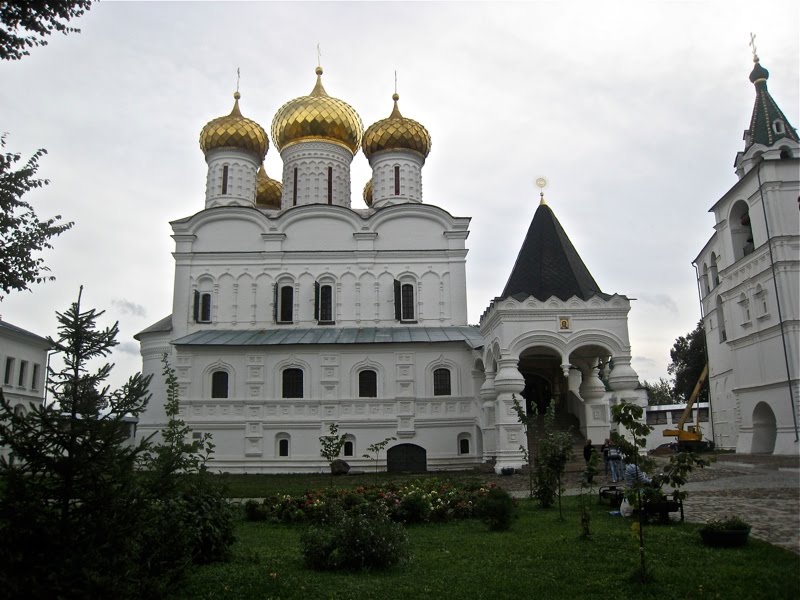
The Cathedral of the Holy Trinity (above) was constructed in the mid-17th century by the Godunov family in imitation of the contemporary Moscow architecture. A team of 19 of the best iconographers were assembled in 1685 and completed the entire church in one summer.

Inside the cathedral, a small side chapel was being renovated, again with Byzantine-style iconography much like we see in Greece today.

In the main part of the cathedral, near the iconostasis on the right-hand side, sits a hand-carved wooden structure that served as the tsar's throne. The one you see in the photo above is an exact replica; the original is in a museum in Moscow.

We were then taken into the monastery's impressive museum, which primarily featured icons and liturgical objects from the 16th-18th centuries. Above is one of the icons on display there.

The last thing we visited inside the monastery was the Romanov house, which is where the family was living when Mikhail was chosen as the tsar who would end the Time of Trouble. You can see the colorful house in the photo above. Inside is a small museum dedicated to the family.

Above is another photo from the inside of the huge monastery complex. Returned to the Church in 2002, the monastery currently has 10 monks.

Unfortunately, this was one of the rare days on our trip when the weather was poor -- rainy and overcast. The photos from the day suffered because of this.

Here we are leaving through the Catherine gates, which were built for the visit of Catherine the Great.

We then headed next door to visit the Museum of Wooden Architecture. In the 1950s, the Soviets decided to construct a dam for hydroelectric power. They moved the houses in that area and reassembled them in this area, forming them like a traditional Russian village along one central street. The buildings range in date from the 17-19th centuries, including two churches.


Above is a photo of one of the two churches. This one is has two altars. The church on the bottom floor is dedicated to the Holy Protection of the Theotokos, the one on the top floor to the Prophet Elijah. The church was originally built in the 16th century, but underwent major renovations many times, through 'til the 19th century.

That's me in front, trying to see if we could go inside.

We had free time to explore this open-air museum at our pace, and I went with Steve and my friend Fr. Romilo, a Serbian monk of Hilandar Monastery who is currently studying at Oxford. Fr. Romilo speaks a little Russian, so we spent quite a long time in this house speaking with the woman in charge of caring for it. She explained that 10 peasants would live in this small house. It's built of aspen and fir logs and was originally covered with straw, and dates to the beginning of the 19th century.

The main room of the house. Notice the icon corner to the right. I've heard that Russian novels foreshadow the bad characters by noting that they do not make a bow toward the icon corner when they enter a house.

The stable was located inside the house, for shared warmth during the long, cold winters. Here's a view from the stable out to the next house.

Here, Fr. Romilo is standing on the bridge in front of the church of the Gracious Savior, built in 1712. It is described as a typical model of the framework type of an old wooden church. The roof is covered with birch bark.

We then had a little free time in Kostroma. Unfortunately, it was raining, so most of us just went to a market to stock up on supplies for the boat. While there, however, Fr. Romilo and I had an interesting encounter with an elderly Russian woman, who insisted on giving us each 100 rubles (about $3) and asked us to pray for her. She was eagerly anticipating Christ's return and was anxious to ask us about this.

The group then headed to the Theophany Women's Monastery, which houses an orphanage, a school, and a care facility for the elderly. Many of the 100 nuns here work as doctors, nurses, and teachers there.

This was also the site of the Theophany Cathedral, which features the famous 800-year-old Feodor icon of the Mother of God (see above), the icon used to bless Mikhail Romanov when he became the first tsar of the Romanov dynasty. We were blessed to venerate it.

Inside this box are small pieces of the relics of all the Optina elders. There were many, many such boxes throughout the churches we visited, full of small particles of relics of a vast number of saints.

Our next stop was the Church of the Resurrection on the Debra, built in 1651 (see above). According to tradition, this is how this church was built: The merchant Cyril Isakov found a barrel of gold among the goods received from London in exchange for canvas. To this merchant's amazement, his English trading partners told him to use the money for a project pleasing to God. It was this money, then, that built the church.

We ended the day with dinner with the Archbishop of Kostroma. In the photo below, he is offered us a toast welcoming us to his diocese. The photo above is of our first dish -- a translucent jelly with mushroom and carrot inside. Mother Nectaria told me this is a traditional delicacy, and is time-consuming to make.

For more photos from the day, click here.