Tuesday, May 12, 2015

Mt Athos, Part 1: Kerasia


I recently had the unexpected chance to go to Mt Athos with my chanter and good friend Nikos, as well as another mutual friend, Apostolis. As is wont to happen, the plan changed drastically, and we ended up spending the whole time with my friend Iakovos, an American convert who studied in Thessaloniki with me and who now is a novice at the cell of St. John the Theologian in Kerasia, one of the most remote and ascetic parts of Mt. Athos.


The cell's elder, Fr. Theologos, kindly sent Iakovos down to get us from the port, along with three mules. It's about a 1.5-2 hour hike straight up from the port (see above) to Kerasia, which is at about 500 meters.


Here I am on my donkey.


And here is the donkey behind me, carrying our bags.


About halfway up, we made a stop in the shade so that Iakovos could disappear into the woods and say "Christ is risen!" to an old Russian ascetic who lives in a shack somewhere hidden in the forest. The purpose was also to check up on him and make sure he was okay.


A bit further up, Iakovos pointed out a small green shack hidden in the forest. This was another ascetic's home.
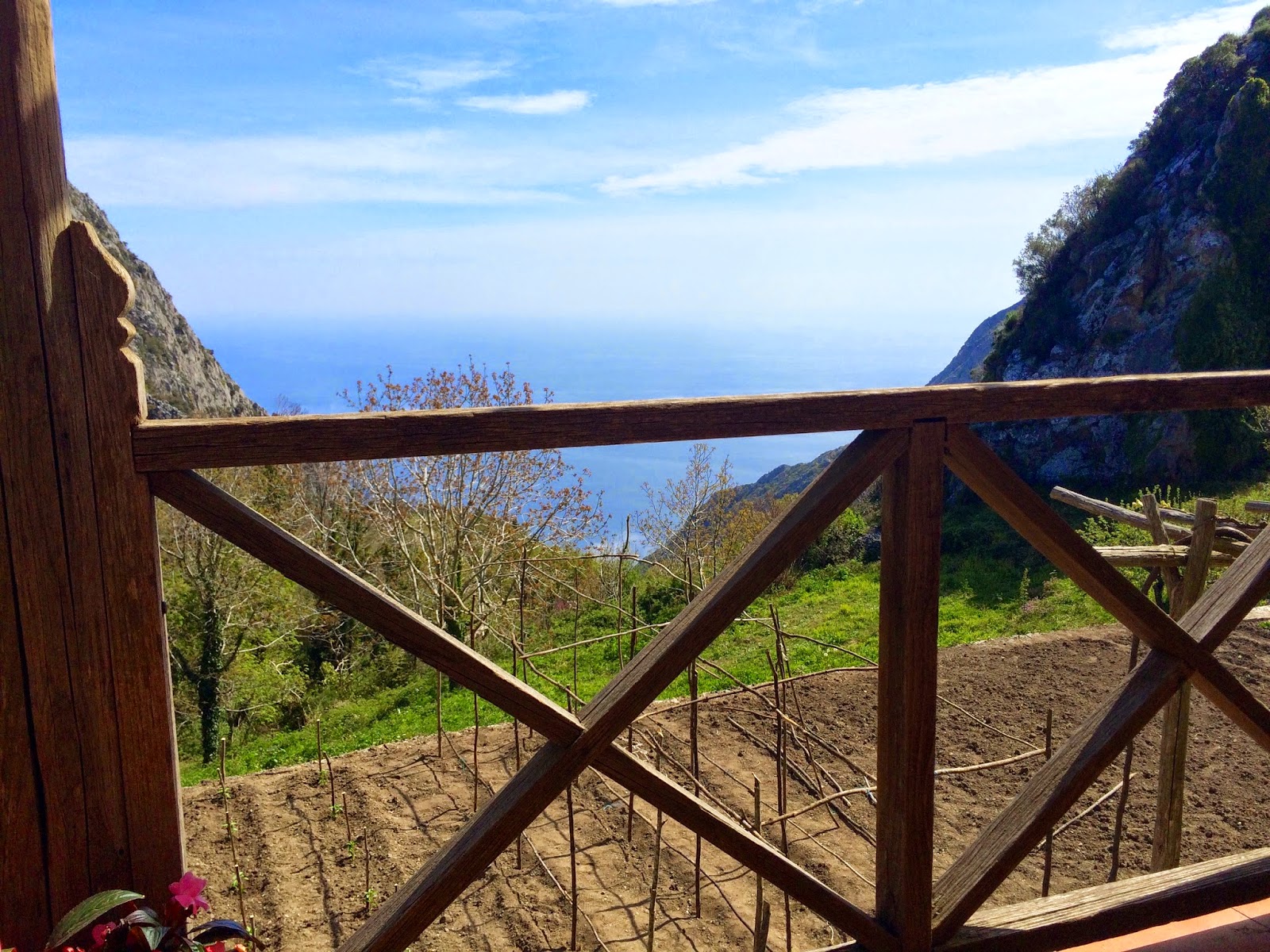

Finally, we reached the cell. We sat on the balcony and enjoyed the traditional Athonite greeting of water, tsipouro (distilled alcohol), and loukoumi ("Turkish delight").


Here are some more photos from the scenic balcony.


Fr. Theologos studied architecture in Paris before becoming a monk, and still works designing churches. His spiritual father, St. Paisios, recommended that he help Archbishop Anastasios of Albania with missionary work, so he spent 10 years as a missionary in Congo-Brazzaville and another 10 years in Albania.

On our final evening with him, we finally managed to get him to sit down with us and tell us stories about his experiences with the newly canonized St. Paisios.

Sunday, May 10, 2015

Around Portaria


Not far from our house, we have a chapel dedicated to St. George, built in 1765, where we celebrate his feast day. Here is a photo from just before we began Vespers service. In the foreground is our friend Alexandros, who immigrated from Afghanistan about 12 years ago. He is now becoming a novice on Mt. Athos. After the service, he told his amazing story in our parish hall, located next door to St. George's, while we had some tea and cookies.


After Liturgy for the feast of St. George, our neokorisa (church cleaner) clowns around at the coffee hour by wearing the beret of one of our parish council members.


We had our first BBQ of the year the other day. The boys love climbing up on the covered area out in our yard.


On Friday, April 24th, the bishop came to celebrate Divine Liturgy for all the school children in Portaria--pre-school, kindergarten, and elementary school. In Greece, there's a actually a law that says kids have to attend church once a month on a school day. This, however, was different. The bishop has been going around doing "Catechetical Liturgies" for school kids of all ages. Essentially, the Liturgy takes place out in the center of the church, and the bishop stops at a few points to explain what is happening in the Liturgy. Everywhere he has gone, the kids--as well as teachers and parents--have been very enthusiastic. Many--if not most--don't understand almost anything that is happening in the church services. 


The kids have been on Portaria's soccer team since the fall, and they recently had their first tournament on a Saturday. Portaria's team is in green. In the background, behind a cypress tree, you can see one of our chapels, dedicated to St. Symeon the Stylite.

Friday, May 08, 2015

Nafplion, Part 3: Palamidi, Nemea, Thebes


On the last day, we began with a visit to Palamidi Castle overlooking Nafplio. It's an enormous castle, built by the Venetians in only 3 or 4 years (1711-1714). Incredibly, though, after building it, they left it manned with only 80 soldiers. It was thus taken by the Ottomans after only 1 year.


The view from the top.


The key attraction for the kids was seeing the prison where Theodoros Kolokotronis was held. We even went down into this cramped, damp, lightless hole, where Kolokotronis spent 10 months awaiting execution, before being pardoned because he was needed to lead a new battle. It seems the Greeks only stop fighting each other when there's someone else to fight.


Here are the girls entering the dungeon cell.


Here are the kids hiding under a series of arches.


What an incredible view. If you squint, you can see Pelagia and Dami out at the end of the castle wall.


And here they are walking down one of the ramps.


After Palamidi, we started the long trek back home, stopping first at the ancient site of Nemea, the site of Hercules' first labor.


Here you can make out the boys sitting at the base of one of the columns of the massive Temple of Zeus. Three of the columns have remained standing since it was built ca. 330 BC.


Here's Dami, with the Temple of Zeus in the background.


Nemea was also the site of the Nemean Games. They recently discovered a tunnel that connected the athletes' locker room with the stadium. Here is everyone walking through the tunnel into the stadium. And here are the boys racing each other, just as they did in ancient times, while Pelagia and Dami stand next to what I guess was an altar.


After Nemea, it was back into the car until we hit Thebes. There is very little left of the ancient city, and the modern town is built around the little that is left. In fact, we ate at a little restaurant that was next to a playground for the kids, as well as an "archaeological site" with no less than three signs denoting it. I couldn't see anything, so I asked, and our waiter pointed at a big rock next to us, covered in weeds and trash, that he said was related to the great ancient Greek poet Pindar. Indeed, there was also a modern monument to Pindar. I've looked into this a little, and the only thing I can guess is that perhaps they say it was the site of the house of Pindar, who was born in Thebes. They say that Alexander the Great spared only his house when he razed the city in 331 BC, out of reverence for the great poet.


That's the rock behind the sign pole.


Finally, we took a brief look at the remains of the city's castle, which are used to house the city's archaeological museum. Unfortunately, the museum was closed for renovations, so we headed home.

For all the photos from the trip, click here.

Wednesday, May 06, 2015

Nafplion, Part 2: Mycenae


We started off the second day by again exploring the city of Nafplio. We even rented a 6-person bike-car, which was extremely difficult to get up even the slightest incline with only 2 of the 6 pedaling. 


Hot from the biking, we then took off our shoes and put our feet in the water. Nafplio has some of the best weather in all of Greece, and it was certainly true during our visit.


In the afternoon, we drove out to the ancient city of Mycenae, the capital of the famous Mycenaean civilization, which flourished from about 1600-1100 BC.


Here are the boys at the famous Lion Gate entrance to the city. The massive stones used to build the walls were conjectured to have been built by cyclopses, as it is difficult to imagine how else they were built. One modern analysis estimates that it would have taken 10 years of continuous work to build the walls using mules, and over 100 years without mules.


The girls were tired of "old rocks piled on top of each other," so it was just the boys and I exploring Mycenae.


The kids have been studying Greek mythology in school, and the boys especially like Hercules, which is part of what inspired our trip, as Mycenae was the seat of King Eurystheus, who usurped the throne from Hercules' family, and who assigned Hercules his 12 labors. During our exploration of the site, we even found the throne room and were able to imagine where the king sat as he devised these labors.


Here's Paul taking a break near the top.


One of the most interesting parts was the cistern, which was basically a long tunnel dug right down the middle of the hill. Without any light at all except the flashlight on my phone, the boys and I walked all the way down to the bottom.


When we came out, the girls were flying our kite in the parking lot. You can see Mycenae in the background, a hill set between two mountains.


And finally, after a lot of exploring in the hot sun, it was time for ice cream.

Monday, May 04, 2015

Nafplion, Part 1: Epidauros


After the stop at the Athens Zoo, it was on to Nafplion, the first capital of the modern Greek state.


Here we are, during our first day in Nafplion, at the statue of Theodoros Kolokotronis, one of the heroes of the Greek revolution. Before Greek Independence Day (March 25), the kids learned in their kindergarten about the revolution and its heroes, and Benny has been particularly enamored with Kolokotronis.


The next stop was the Church of St. Spyridon, where another hero, Ioannis Kapodistrias, the first president of Greece, was assassinated. We even inspected the hole in the wall left by the bullet that missed him. After visiting that small church, we wandered around the alleys (see above), eventually making our way to the Archaeological Museum of Nafplion.


Afterwards, we stopped by a very nice park on the seaside.


And then had a pizza on the boardwalk. In the background you can see the island of Bourtzi, which hosts a Venetian castle. Unfortunately, the castle was closed for repairs, so we didn't take the boat over to the island.


On the hill in the background of the photo above, you can see another Venetian castle, the large Palamidi Castle, which overlooks the city.


In the afternoon, we headed over to the ancient site of Epidauros. On the way, we stopped by what is claimed to be the oldest surviving bridge in the world, built by the Mycenaeans about 1200 BC.


And here we are exploring the ancient site of Epidauros, which was a cult site for the worship of Asclepius, the healer god, from at least the 6th c. BC.


Epidauros was, in fact, the most famous healing center in the ancient world. There was a large, long, rectangular building called the enkoimeteria, i.e., the sleeping hall. Those who were sick would sleep in this hall, and the Asclepius would appear to them in their dreams to advise them of their course of treatment. The museum at the site even displayed some of the surgical instruments that doctors of that time used there. The kids had fun pretending to be asleep on the benches that have been preserved in the hall.


The site was also connected with games held in honor of Asclepius. In the background of the photo above is the race track. You can discern the posts demarcating the runners' lanes.


Here's Dami in front of a section of the sleeping hall.


Here we are walking over to the famous theatre. Dami is trying on Pelagia's sunglasses.


And here's the theater. The kids ran up to the top. Here's Phoebe running back down again.


We spent quite a long time in the theatre testing out the acoustics, which were truly astonishing. In the photo above, you can barely see the kids all the way at the top of the theatre on the opposite side. Despite the distance, we could hear each other perfectly clearly. As for the people standing at the center of the stage, you could even hear them snap their fingers.


The kids ran back and forth to the other side to test out the sound, as well as up and down. They had an excellent workout. They say that the acoustics are achieved both by the design as well as by the materials used in construction (limestone, marble, etc.).

Stay tuned for more posts from the trip.