Monday, July 12, 2010

Trip to Constantinople

With my mother-in-law here to help with the babies, I had the opportunity to accompany a small group from our parish in a short trip to Constantinople/Istanbul. For those who don't already know this, Istanbul is actually from the Greek as well. Constantinople was simply called "the city" by the Greeks (or "the city of cities," more formally), and in the Greek of the Byzantine era, "εις την πόλη" (pronounced "ees teen mbolee) meant "to the city," i.e. Constantinople. So to the Turkish name for the city is simply a derivation of this common Greek way of referring to it.

Anyway, we left the church at 6:00 AM Monday morning in the church's minivan and headed east toward Turkey. The region of Greece we passed through, called Thrace, is quite scenic. Much of it is farmland, and sunflowers are one of the most common crops, used for oil and bio-fuels. We stopped for a coffee after about 2 hours of driving and I took this photo of one of the sunflower fields along the road.

We reached the border with Turkey after about 4 hours. The Greeks were able to pass through quickly using only their national identity cards (i.e., no passports), while I, as a citizen of a country that provides Turkey with billions and billions of dollars in free money every year, had to stop and pay $20 for a tourist visa. (No questions are asked for security reasons or anything like that; it's simply a matter of forking over the money.)

After another 3 hours, we were in Constantinople. The city has around 15 million residents, depending on how you count, and is the fourth largest city in the world. Thus, it's not surprising that we hit a wall of traffic once we were about 20 km outside the city. Finally, though, we made our way to Panagia Vlahernon. Click here for the story of this site's importance.

In the photo above, Fr. Alexios and Fr. Panayiotis are standing with the site's caretaker, with the wonder-working icon of the Panagia to the left, and the spring of holy water to the right.

Here's Fr. Panayiotis walking back down the vine-covered walkway to the entrance.

After some frightful traffic, we finally found our way over to the famous Chora Church, which I had not had the chance to go to in my first visit to the city with Pelagia nearly four years ago.

Like Hagia Sophia, it is now operated by the Turks as a museum, but it is a must-see. The mosaics are simply the most beautiful I've ever seen.

A shot from below, looking up at one of the domes inside Chora Church, with me, Paris, and Fr. Alexios looking down.

Fr. Alexios looking at the famous fresco of the Resurrection, which has adorned many books.

Fr. Panayiotis standing in front of the former sanctuary area of the church. The addition of the mihrab demonstrates that it was later used by the Turks as a mosque.

The exo-narthex.

A beautiful mosaic of the Apostle Paul, at the right-hand side of the central entrance into the narthex.

This mosaic was the most beautiful I've ever seen. The photos can't do it justice.

Yet another famous mosaic, above the entrance to the narthex.

The front of the church/museum.

Here's a shot of our hotel in the touristy Taksim area of Istanbul.

After checking into our hotel, we went out for a walk in the evening in search of something to eat. Taksim is full of wide pedestrian boulevards with lots of restaurants. Here was a buffet-style place with lots of options.

After dinner, we went up to the roof of our hotel for a view out over the city. The blue lights decorate one of the bridges of the city.

For more photos from day one, click here.

For a retrospective, click here to see the blog from nearly 4 years ago, when Pelagia and I visited Constantinople. Look in the column on the right hand side for the 11 or so posts related to the trip.

Saturday, July 10, 2010

July 4th in Greece

Last Sunday, July 4th, we were invited, along with Fr. Panayiotis and his family, to my Byzantine music teacher's house. Manoulis, who is the protopsaltis at the Byzantine Church of the 12 Apostles and now professor of Byzantine Music at the university, lives outside Thessaloniki toward the north (Panorama is toward the east).

With Fr. Panayiotis' 5 kids, and Manoulis' 5 kids, plus other guests, there were plenty of kids for the babies to play with. In the photo above, Paul is looking out at the guys as they grill up the meat, which included some very good Greek buffalo sausage.

Here Phoebe and Paul are swinging with Kh. Sophia.

Paul came to hang out with the guys as we grilled and learn the male secrets. Here he's sitting with Fr. Panayiotis and supervising the grilling.

Here are all the babies having fun with their mom on the swing.

Since it was July 4th, we tried to make it an American celebratory BBQ. Greeks have many such national traditions and are always interested in learning about the few such traditions we have, so Kh. Sophia made a jello-based tribute to the American flag, and we brought some sparklers.

Here the babies were having a conference about the basketball.

Friday, July 09, 2010

The Babies Hit the Beach with Yiayia

I've just returned from a short trip to Constantinople, and I have a bit of a backlog of photos and posts to make here. Look for (hopefully) more frequent posts over the next few days.

First, here are some photos from our trip to Nea Kallikrateia beach in Halkidiki last Friday. It was the babies' second time swimming at the beach, and they seemed to enjoy it even more this time, as you can see from the photo above of Paul swimming with his yiayia. Paul especially enjoyed it and it seemed like he was trying to swim.

Here's Phoebe splashing her way into the water, as Benjamin crawls along the shoreline playing in the wet sand in the background.

Here's Phoebe crawling over to her yiayia.

Benjamin was the most taken with the sand, and he spent most of the time digging a big hole in the wet sand and then sitting in it. Here he's relaxing with his yiayia.

There was a nice little restaurant right next to the spot we were swimming, so it was easy to walk over and get something to eat. We ordered some fresh, fried kalimari and I had the idea to cut off the little legs and see if the babies wanted to chew on them. To our surprise, they really seemed to like them. Here's Paul chewing on his fried squid leg. They're real Greek babies now!

Here was the scene at the table. At bottom, you can see Paul walking around with the squid leg hanging out of his mouth. In the background, you can see the beach where we were swimming.

For a couple more photos, click here.

Tuesday, July 06, 2010

St. Paul's

Last Thursday afternoon, we went to the section of the city called St. Paul to venerate the relics of Paul's namesake. The area is just outside the old city walls to the northeast, and it features a park that contains the cave where St. Paul slept when he was run out of the city, and three churches dedicated to him. The first is basically a small shrine built around the cave where he stayed. The second is a modestly sized church built after the mayor of St. Paul had a dream in which the saint appeared to him and asked for a more appropriate church, and the third is an extremely large and beautiful church built in just the last few years. It was to this latter church that we went to venerate the saint's relics, which you can see above. In the photo below, Paul is venerating them.

A view down the central aisle of the church. They are currently working on a part of the iconography in the apse. Below you can see what has been completed.

As an interesting side note, here in Thessaloniki, in addition to the normal apolytikion for both St. Peter and St. Paul, we also sing a special apolytikion written only for St. Paul. This was written perhaps 80 years ago here in Greece and is used in the local churches that St. Paul himself founded, such as Thessaloniki.

After the church, we walked over to have a coffee overlooking the city. In the photo above, you can see Pelagia with Benjamin. He wanted to drink some of her coffee. Above Pelagia's head you can see St. Paul's.

These days, the city is very hot and humid, especially when you're hiking around with three babies. One of the cafes had a mister. Here Kh. Sophia is walking through it with Phoebe.

We then went to a park so the babies could play. Here's Paul playing with a stick he found. Behind him is the church dedicated to his saint.

Here's Benjamin climbing on the fence. You can see St. Paul's. The fence encloses the old park, which contains the cave where St. Paul stayed. It belongs to a private Christian organization and is not always open.

For more photos from the outing, click here.

Saturday, July 03, 2010

The Babies Visit St. Theodora's

On Tuesday, Paul, of course, celebrated his Name Day. We had Liturgy in the morning, followed by a lovely lunch with lots of meat in the afternoon. In the evening, we had a small party, and Paul's godfather, Paris, came over.

The next day, we took a little outing into the city to run some errands, and we stopped by the Monastery of St. Theodora's for the babies to see the church and play in the courtyard. The monastery no longer really functions as a monastery, since it is located right in the heart of the city, but serves basically as a place for unmarried clergy to stay, including visiting clergy. It is dedicated to two Thessaloniki saints, St. Theodora and St. David, both of whose complete relics grace the small church.

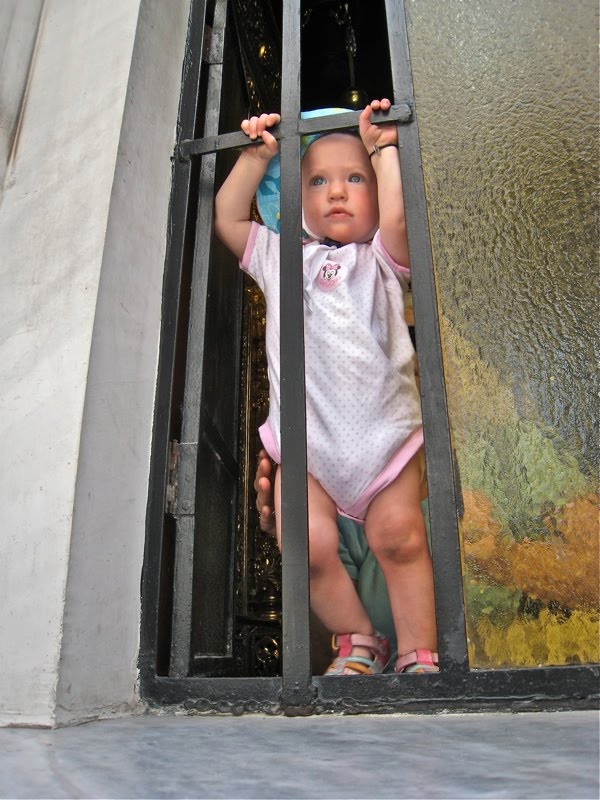
We found an open window at the left-hand side of the iconostasis, and the babies enjoyed standing in the window sill on both sides and peering through. In the photo above, Benjamin called out to Yiayia (Grandma) Sophia and Phoebe, who were out in the courtyard.

Here, Yiayia and Phoebe are venerating the relics of St. David of Thessaloniki. The small room containing his relics also contains extensive iconography chronicling the saint's life.

Here's Phoebe looking out the window from inside the church.

And here's Benjamin outside, looking back in.

Yiayia and Phoebe in the courtyard.

Here's Paul looking up at a mosaic of his namesake, which is located at the entrance to the church.

Thursday, July 01, 2010

The Monasteries of Volos

On Saturday, I had to go down to Volos for something, so Paris and I used it as an opportunity to visit two of Volos' monasteries. First, we went to the monastery dedicated to the Panagia Odigitria (The Virgin Who Leads the Way) icon, which is a dependency of the Holy Monastery of Philotheou on Mt. Athos.

There we had a very nice long talk with Fr. Parthenios, a priest-monk from the Holy Monastery of Karakallou on Mt. Athos, who was there to serve the monastery for a few months. We then ran into Sister Taxiarcheia, a nun who spent several years at their sister monastery of St. John the Forerunner in Goldendale, Washington.

From there, we headed further up the mountain to the Monastery of St. Gerasimos, located just above the high mountain village of Makrinitsa in the Pelion mountain range. There we were blessed to venerate the skull of St. Gerasimos the New (16th c.), who was friends with his fellow monk, St. Dionysius of Olympus.

Inside the church, we noticed the unique icon in the photo above. It depicts the saving ark of the Church and says, "Hold On to the Traditions."

This is a photo of the entrance to the small women's monastery of St. Gerasimos, which has about 15 nuns. We also had the opportunity to speak for a while with the abbess before we headed back down the mountain a few minutes to Makrinitsa.

In the picturesque little mountain village of Makrinitsa, we took a walk through the cobblestone streets and went inside the old chapel dedicated to St. John the Baptist in the town square. We then had a coffee with a view down over the city of Volos.


View Larger Map

We then started the trip back to Thessaloniki. About 45 minutes outside Thessaloniki, we stopped at a little seaside village called Methoni (see map above), which is known for its fish restaurants.

The photos above and below are of our table right on the beach, as we stopped for a late lunch there. We had really delicious fresh octopus and kalamari.

For a few more photos, click here.